Cube nets: which of these three shapes folds correctly?
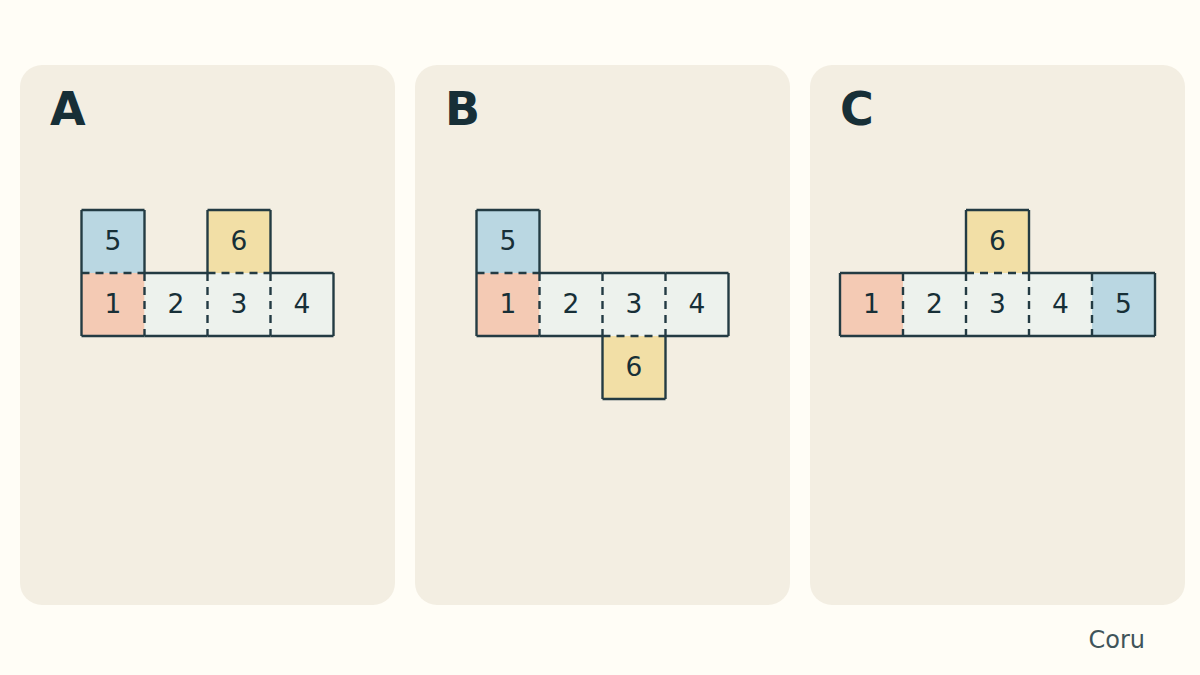
All three shapes have six equal squares. Only one can become a closed cube without overlapping faces. Before cutting, choose A, B or C and find a reason: counting to six is not enough.
Six squares, six different places
A cube net is a flat shape that can fold into the cube’s six square faces. In this challenge, squares stay joined along their shared edges: you may fold along those lines, but you cannot cut extra joins, stretch the paper or overlap faces.
Imagine that each square needs its own place. If two end up in the same spot, you will not have a complete cube, even though you counted six squares. The numbers help you track faces; they are not the dots on a die.
Download the three shapes and answers
Two-page PDF: cut-out shapes on page one; answers on page two. You can solve the puzzle on screen without printing.
Look at each shape closely
Solid lines mark the outline; dashed lines separate joined squares. Use the numbers as well as the colours. To try the puzzle unaided, choose before continuing to the hints.
A hint: follow one face
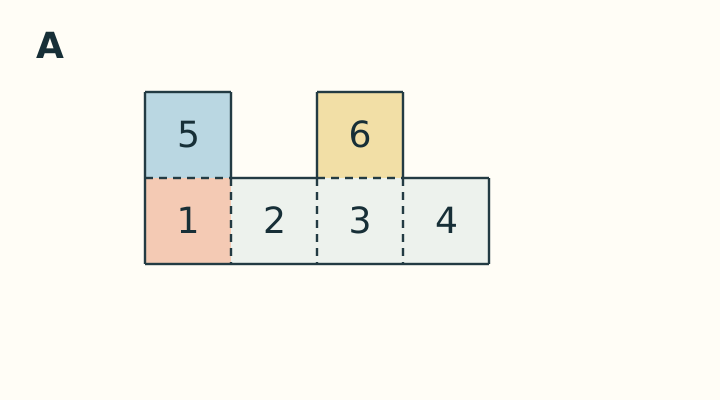
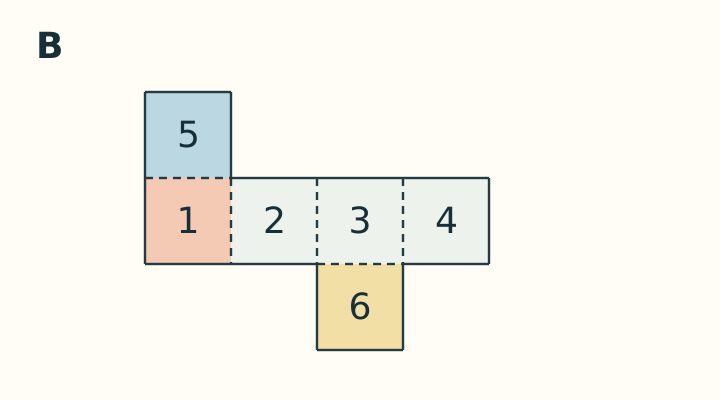
In A and B, imagine the row of four squares wrapping around the sides of a box. Follow 1, then 2, 3 and 4. Two openings remain to be closed. Where does each added square end up?
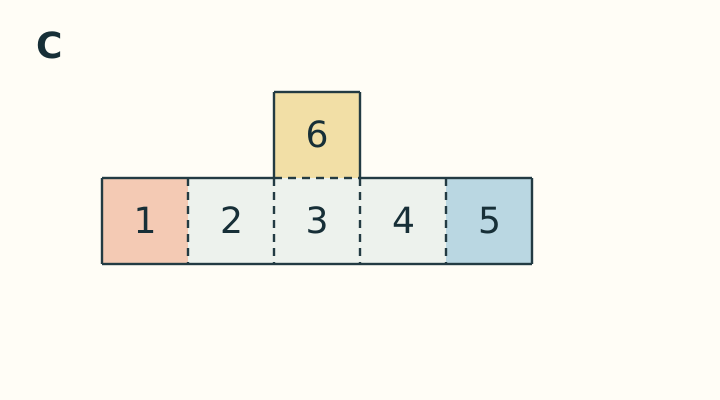
In C, think about continuing the circuit after the fourth square. Looking roughly like a cross is not enough: follow each face to its final position.
Check your choice
Choose a shape and explain where each face would go. Use the buttons, or open “Answers and explanations” to compare all three options.
Answers and explanations
- A: A does not work: 5 and 6 reach the same opening and overlap.
- B: B works: the row wraps around four sides; 5 and 6 close opposite openings.
- C: C does not work: the fifth square in the row lands on the first.
The answer: B
In B, the row 1–2–3–4 wraps around four sides of the cube. Face 5 closes one opening; face 6, on the other side of the row, closes the opposite one. Each of the six squares occupies a different place.
Opposite faces are 1 and 3, 2 and 4, and 5 and 6. Faces 1 and 4 meet when the row closes; they are not opposite. You can check these pairs on the paper model.
In A, 5 and 6 try to close the same opening. When folded, one lies on the other and the opposite opening has no face. In C, the first four squares of the row have already completed a circuit: 5 repeats the position of 1.
Check with paper
Print only the PDF’s first page to keep the answers separate, or copy the shapes onto squared paper. Make every square the same size and keep the numbers.
Cut along the solid outline, keeping the squares connected. Fold along the dashed lines and raise the faces to form right angles. Ask an adult for help with scissors if needed. The sheet has no tabs: hold the model with your fingers; no glue is needed.
Start with the row, then try the added faces. In A and C, stop when two faces try to occupy the same place: do not fix it with an extra cut. That collision is precisely what you are checking.
Change just one piece
Return to A and move only square 6 to the other side of the row, below 3. You now have B. Explain what changed: not the number of squares, but where one face ends up.
To go further, rotate the whole drawing of B on the paper without changing its joins. It still makes the same cube. A rotated shape may look different, but it is not a new way to connect its faces.
Where the exercise starts
INTEF proposes predicting, folding and explaining which arrangements form a cube. Nueva Escuela Mexicana describes overlaps and missing faces as signs of a shape that does not close; NRICH uses cut-outs to investigate nets. Coru created these numbered drawings, the comparison of errors, the text and the worksheet.