How to read an analog clock: follow the hour hand
The hour hand moves between numbers. Follow the hour it has passed, count the minutes, then practise with six clocks and explained answers.
Start with the hour hand
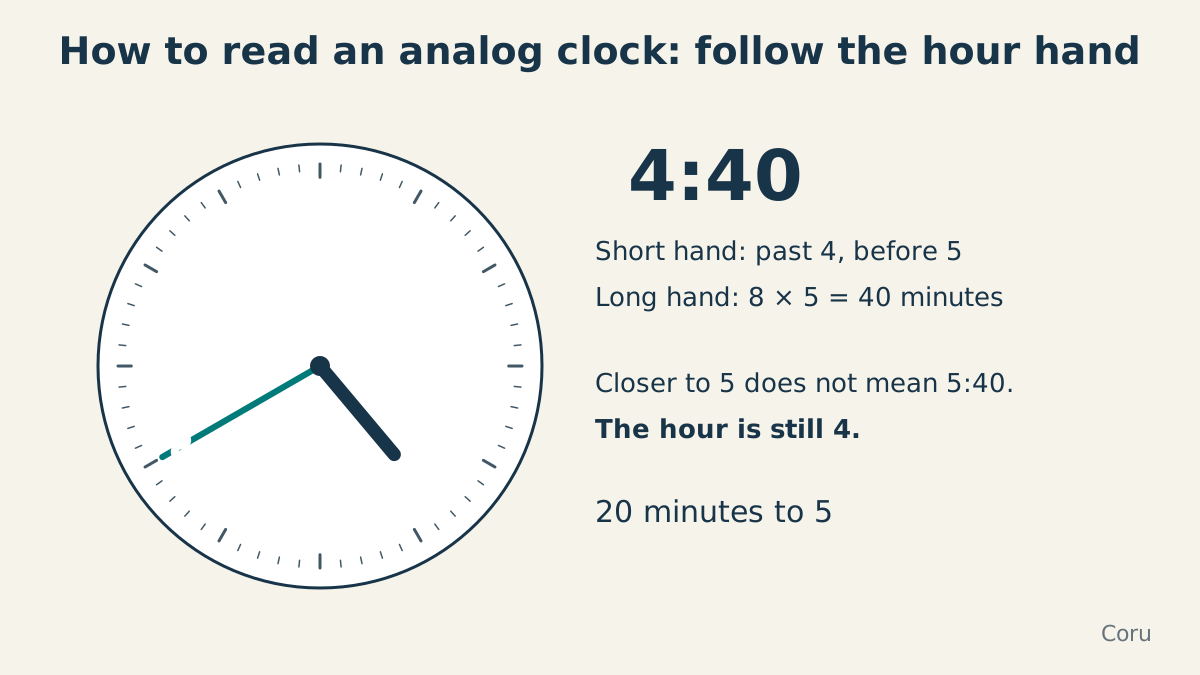
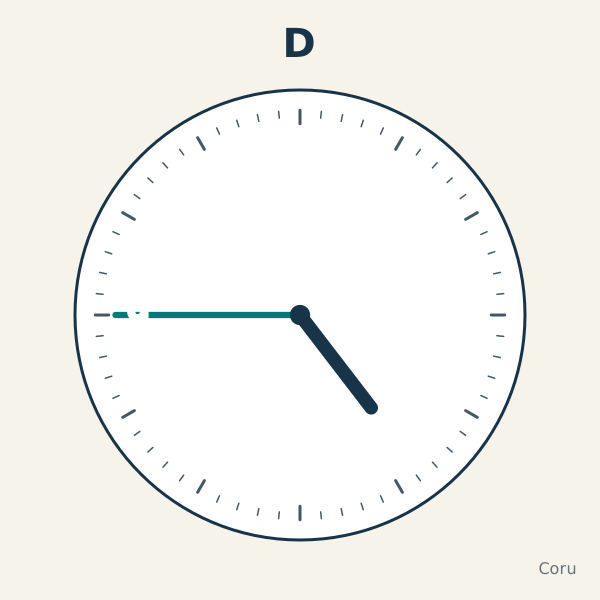
A short hand that is close to 5 does not always mean the hour is 5. At 4:40 it is already nearer to 5 than to 4, but the time still begins with 4. Read the number it has passed as it moves clockwise, then read the minutes.
This lesson uses a standard twelve-hour dial with two hands and sixty minute marks. The shorter, thicker hand shows the hour; the longer, thinner hand shows the minutes. Colour helps you follow the drawings, but length and thickness distinguish the hands too.
Read it in three steps
- Find the hour. Follow the short hand clockwise from 12. If it is between two numbers, use the number it has passed. Between 12 and 1, that number is 12. If it points exactly to a number and the minute hand is at 12, use that hour.
- Count the minutes from the top. The long hand at 1 means 5 minutes, at 2 means 10, at 3 means 15, and so on. Each small interval is one minute. At 12, a new hour starts with 00.
- Join the two readings. Write the hour, a colon and two minute digits: 4:07, for example. Check that the hour hand is still in the interval you named. Do not round it to the nearest number.
Why both hands matter
In one hour, the minute hand makes a complete turn while the hour hand moves to the next number. After 15 minutes, the hour hand is a quarter of the way along that interval; after 30, halfway; after 45, three quarters of the way.
In the worked example, the long hand points to 8: eight groups of five make 40 minutes. The short hand is between 4 and 5, so the time is 4:40. “Twenty to five” names the next hour because 60 − 40 = 20. It does not change the written reading to 5:40.
Six clocks to read
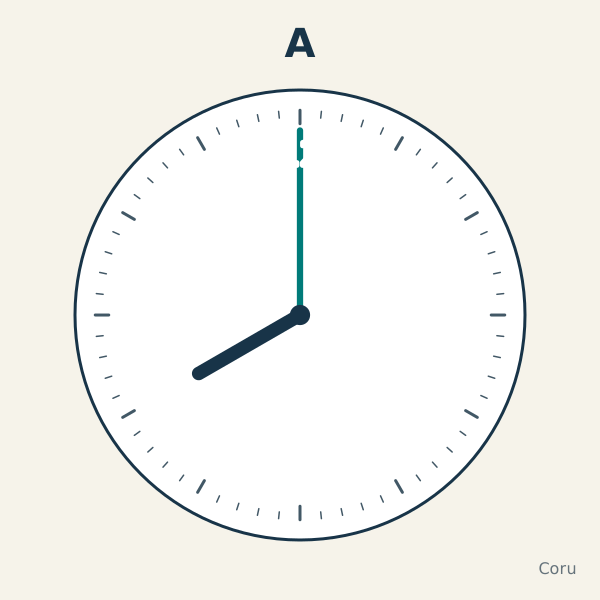
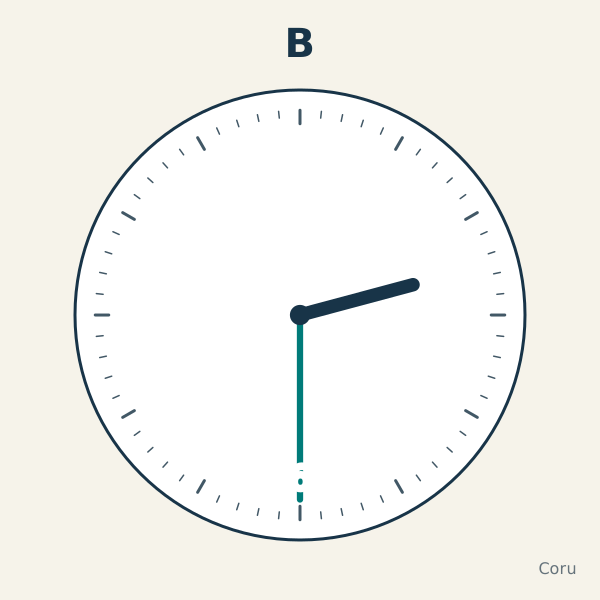
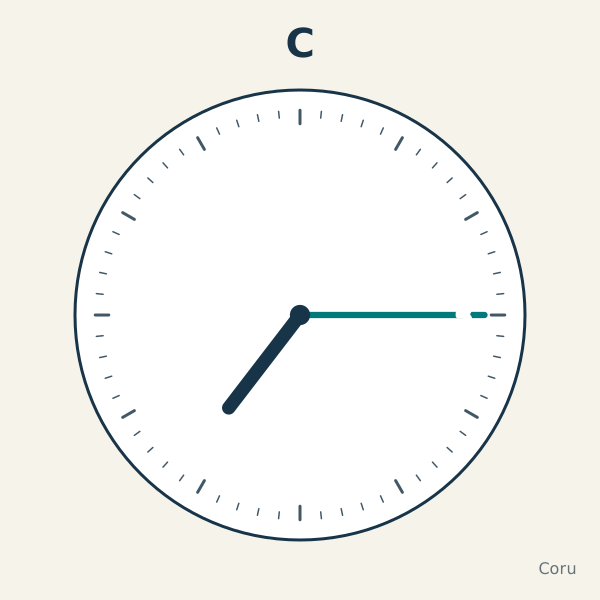
Write A to F on paper. For each clock, record the time and finish this sentence: “The short hand has reached or passed ___; the long hand shows ___ minutes.” Start with A and B, then try C and D. For E and F, count the individual minute marks.
The answers are below all six clocks. There is no time limit. If you use an image description, work from the stated hand positions rather than guessing from the exercise label. The PDF puts the exercises and answers on separate pages.
Printable worksheet: six clocks and answers
Two A4 pages: six exercise clocks on page 1, explained answers on page 2. Print the first page separately if you want to keep the answers out of view.
Answers and the reason for each
- A: 8:00. The short hand is on 8 and the long hand is on 12. At the top of a new hour, write 00 minutes, not 60.
- B: 2:30. The minute hand points to 6, so 6 × 5 = 30. The hour hand is halfway from 2 to 3: half past two.
- C: 7:15. The minute hand points to 3, giving 15 minutes. The hour hand has moved a quarter of the way from 7 to 8: quarter past seven.
- D: 4:45. The minute hand points to 9, giving 45 minutes. The short hand is close to 5 but has not reached it. This is quarter to five.
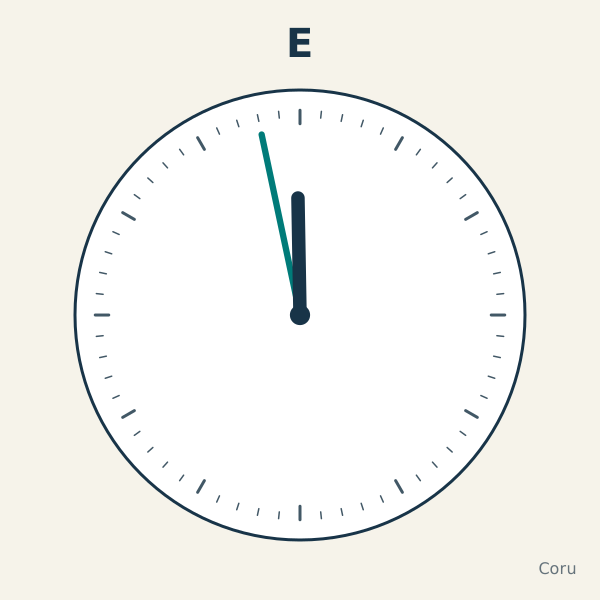
- E: 11:58. Count 55 at the 11, then three more minute marks: 56, 57, 58. The hour hand is almost at 12. Two minutes remain until 12:00.
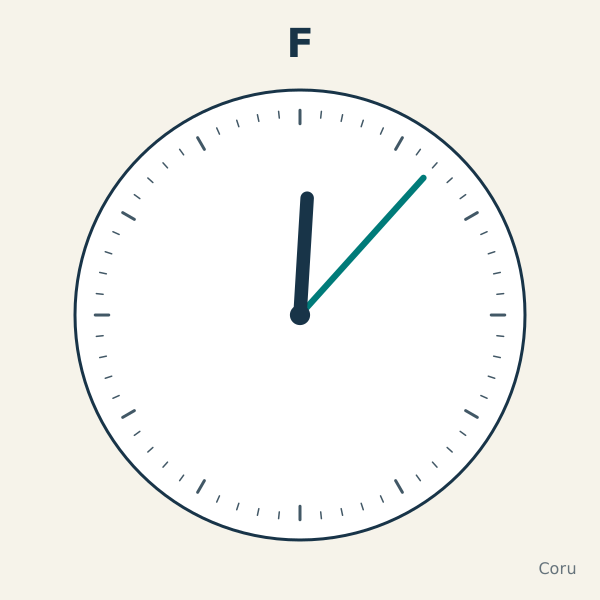
- F: 12:07. Count 5 at the 1, then two more marks. The hour hand has already passed 12 toward 1, so the hour is 12. The dial does not tell you whether this is after midnight or after noon.
Two mistakes worth catching
If you wrote 5:45 for D, you rounded the hour hand forward. It is near 5 because most of the hour has passed. Return to the last number it passed: 4. If you wrote 12:02 for E, you counted the minutes remaining instead of the minutes already past 11. Both quantities are useful, but they belong to different ways of saying the time.
For F, 12 is an hour number and the top of the minute scale at the same time. The minute hand has passed the top and is at 07; the hour hand has passed 12. Keeping the two scales separate prevents a reading of 1:07.
Draw one yourself, then explain it
Draw a clock showing 6:20. Put the minute hand on 4. Place the hour hand one third of the way from 6 to 7, because 20 is one third of 60. If you leave it exactly on 6, your drawing loses the movement this lesson is practising.
A plain twelve-hour dial cannot establish morning or afternoon, the date or the time zone. For an appointment, add that information from the actual arrangement. Reading the hands also does not establish that a real clock is set correctly.
About this practice
NCETM’s time lessons connect the moving hour hand with positions between numbers and build the minute scale by counting in fives. Coru created this explanation, the six exercise clocks and the printable sheet. The drawings use proportional hand movement. Try explaining both hand positions when you check an answer.